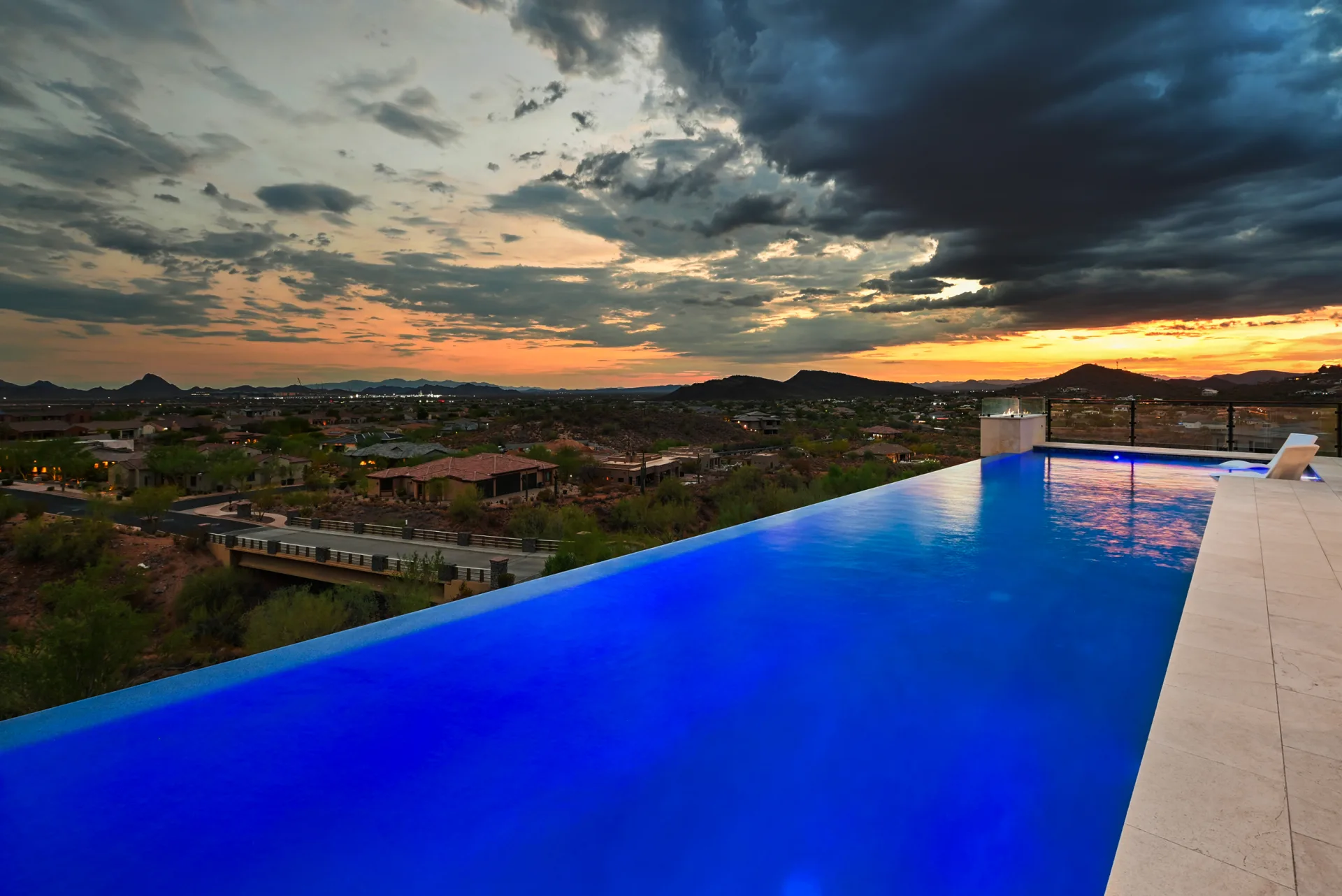
An infinity edge pool, also called a negative edge or vanishing edge pool, is one of the most recognizable features of a luxury desert home. Done well, the water appears to run straight into the mountains or the city lights. Done poorly, it reads as a pool with a wall in the wrong place. This guide walks through how we plan an infinity edge as part of the whole home and site, the same way our pool and landscaping work is planned alongside every custom home we build.
What an Infinity Edge Pool Is
An infinity edge pool has one or more sides where the water spills over a weir wall set flush with the water line instead of stopping at a raised coping. The water falls into a lower catch basin, is pumped back up, and returns to the main pool. From the house, the eye sees an unbroken water surface meeting the horizon.
The terms infinity edge, negative edge, vanishing edge, and zero edge describe the same idea. Zero edge sometimes refers to a pool where all four sides overflow into a perimeter trough, which creates a mirror effect rather than a view effect. Both approaches have a place, and the right one depends on what sits beyond the pool.
Start With the View, Not the Pool
The edge only works if there is something worth looking at past it. Before a pool shape is drawn, we stand on the lot at the height of the great room floor and the primary suite and study where the strongest view sits. On hillside lots in Paradise Valley and Fountain Hills, that is often a ridge line or a long valley view. On city-facing lots, it is the grid of lights at night.
- Set the edge perpendicular to the primary view line from the main living space.
- Check the sightline from a seated height, not only a standing one, since most time outdoors is spent sitting.
- Confirm nothing in the foreground, such as a neighbor roofline or a utility pole, lands right at the edge.
- Look at the view at sunset and after dark, because that is when the pool is used most in the warm months.
How Site Grade Shapes the Design
An infinity edge needs a drop on the far side to hide the catch basin below the sightline. Sloped lots provide that drop naturally. Flat lots can still work, but the pool and deck are usually raised, or the catch basin is set into a lowered terrace, and the design has to account for that added height from the start.
Grading, drainage, and retaining walls are decided at the same time as the house pad. Setting the pool elevation after the home is framed limits the options and often leaves the edge a few inches too high or too low to read correctly from inside.
The Catch Basin and Weir Wall
The weir wall is the precise part of the pool. Its top must be dead level along its full length, because even a small variation shows up as water sheeting unevenly or a dry spot on the edge. The weir is formed and finished with tight tolerances and is usually capped in stone or tile set to a single elevation.
- The catch basin has to hold enough water to cover what is in motion over the edge, plus what the wind pushes out and what evaporates.
- A basin that is too small can run the pump dry; one that is too large wastes space and water.
- The outside face of the weir is visible from below, so its finish matters as much as the pool interior.
- An automatic water leveler on the basin keeps the system balanced through the Arizona summer.
Structure and Engineering
A vanishing edge pool is heavier and more complex than a standard pool, especially where it sits on a slope or cantilevers past a retaining wall. Soils reports, structural engineering, and the pool engineer's drawings need to agree with each other and with the home's foundation design.
On hillside and expansive soil sites, the pool shell may need deeper footings, piers, or a thicker structural section on the edge side. These decisions are coordinated during design so the pool, the retaining walls, and the house footings are designed as one system, which is part of how we approach every project in our process.
Designing for Arizona Heat, Wind, and Dust
Desert conditions affect how an infinity edge performs. Evaporation rates are high in summer, and the moving water over the weir increases them. Afternoon winds and monsoon storms push water and debris over the edge and into the basin.
- Plan the pump schedule so the edge runs when you are using and viewing the pool, not around the clock.
- Choose finish colors that stay comfortable to the touch in direct sun.
- Position the basin and equipment so debris can be cleaned without climbing a steep slope.
- Use a pool cover or shade structures where they fit the design to reduce heat gain and water loss.
Finishes, Color, and the Look of the Water
The color of the pool interior controls how the water reads against the sky. Darker interiors in gray, charcoal, or deep blue create a stronger reflection and make the edge disappear. Lighter finishes read as a bright tropical blue and show the pool floor clearly.
Coping and deck stone should relate to the materials of the house. On a modern desert home with stone and plaster, a honed stone coping and a tile waterline in a muted tone keep the pool quiet so the view remains the focus. The edge itself is often wrapped in the same tile as the waterline for a continuous line.
Lighting the Pool After Dark
Much of the time spent around a desert pool happens after sunset. Lighting should support the view rather than compete with it. Too much underwater light turns the pool into a bright rectangle that blocks the city lights beyond it.
- Use fewer, well-placed pool lights and dim them to a low level on evenings when the view is the point.
- Light the face of the weir wall or the catch basin softly from below so the edge has presence from the lower yard.
- Keep deck and landscape lighting low and shielded, which also respects dark sky expectations in many desert communities.
Connecting the Pool to the House
An infinity edge pool performs best when it feels like an extension of the main living spaces. Aligning the pool with the great room glass, matching the deck elevation to the interior floor, and setting shaded seating and outdoor kitchen areas off to the side keeps the central sightline open.
You can see how this comes together in the negative edge pool and view terrace at our Praiano Way project in the portfolio. For broader backyard planning, including spas, ramadas, and sport areas, see our guide to planning the pool and backyard.
Frequently Asked Questions
- What Is a Negative Edge Pool?
- A negative edge pool has one or more sides where water spills over a level weir wall into a lower catch basin. From the main viewing point the water looks like it runs straight into the horizon.
- Is an Infinity Edge Pool the Same as a Zero Edge Pool?
- They are related. Infinity edge usually means one or two overflow sides facing a view, while zero edge often describes a pool that overflows on all sides into a perimeter trough for a mirror-like surface.
- Do You Need a Sloped Lot for an Infinity Pool?
- A slope makes it easier because the catch basin can sit below the sightline. On flat lots the pool or deck is raised, or the basin is set into a lower terrace, and this is planned alongside the house pad.
- How Does a Negative Edge Pool Work?
- Water flows over the level weir into the catch basin, and a pump returns it to the main pool. An automatic leveler keeps the basin topped off, which matters in the Arizona heat.
Start the conversation