The landscape is the first thing anyone sees and the last scope to get attention on most projects. That order is backwards. Grading, drainage, tree locations, irrigation sleeves, and lighting conduit all get buried under paving and decomposed granite, so they have to be right during construction of the custom home, not after. Here is how we plan desert landscaping on a luxury home in Scottsdale and across the Valley, and what separates a yard that matures into something beautiful from one that looks tired in three summers.
Desert Landscaping Starts With Grading And Drainage
Before a single plant is selected, the site has to shed water. Valley monsoon storms drop heavy rain in short bursts onto ground that absorbs very little, so the yard has to carry that water away from the house, around the patios, and out to the street or a retention area without cutting channels through the planting beds.
That means finish grades, swales, area drains, and retention are laid out with the architect and civil engineer during design, then held during construction. Fixing drainage after the hardscape is poured means demolition, which is why we walk grades with the landscape contractor before any flatwork goes in.
Shade Trees Are The Most Valuable Thing You Plant
Nothing changes how a desert yard feels more than canopy. A mature ironwood over a seating area drops the perceived temperature enough to make the space usable months longer each year, and it softens the scale of a large single-story elevation better than any wall detail.
- Ironwood: slow, dense, long-lived, the best specimen tree for a focal position
- Palo blanco: light canopy and pale trunks, excellent against dark plaster or stone
- Velvet mesquite: fast canopy for shading a patio or motor court, needs structural pruning
- Blue palo verde: bright green trunks and spring bloom, best set away from paving
- Ficus and citrus: only in protected courtyards with frost cover and irrigation reliability
Tree pits get located before the paving plan is finalized. A 36-inch box tree needs a real hole, root space, and a dedicated irrigation zone, not a cutout squeezed into leftover space at the edge of a driveway.
Planting Palettes That Hold Up In Reflected Heat
Plants near west-facing walls, pool decks, and driveways live in reflected heat that runs well above ambient. A palette that thrives in an open desert wash will scorch in that position, so we zone the palette by exposure rather than picking a single plant list for the whole property.
- Structure: agave, ocotillo, golden barrel, saguaro where the setting and permits allow
- Mass and color: hesperaloe, damianita, ruellia, valentine bush for seasonal bloom
- Screening: hopseed bush, Baja ruellia, or bamboo muhly instead of hedges that need constant shearing
- Soft edges: deer grass and muhly grasses along walls and pool coping
- Accent: aloes and euphorbias in shaded courtyard corners where reflected sun is limited
Irrigation Has To Be Designed, Not Improvised
Irrigation is the system that keeps a six-figure landscape alive, and it is the one homeowners see the least. We want mainline routing, sleeve locations under driveways and patios, valve boxes in accessible and screened positions, and a controller mounted where someone will look at it.
Drip zones get grouped by water demand and exposure, so trees are not on the same valve as accent shrubs. On larger lots we add a separate zone for new plantings during establishment, and flow sensing so a broken lateral does not run for three days unnoticed.
Hardscape, Paving, And Walls Set The Frame
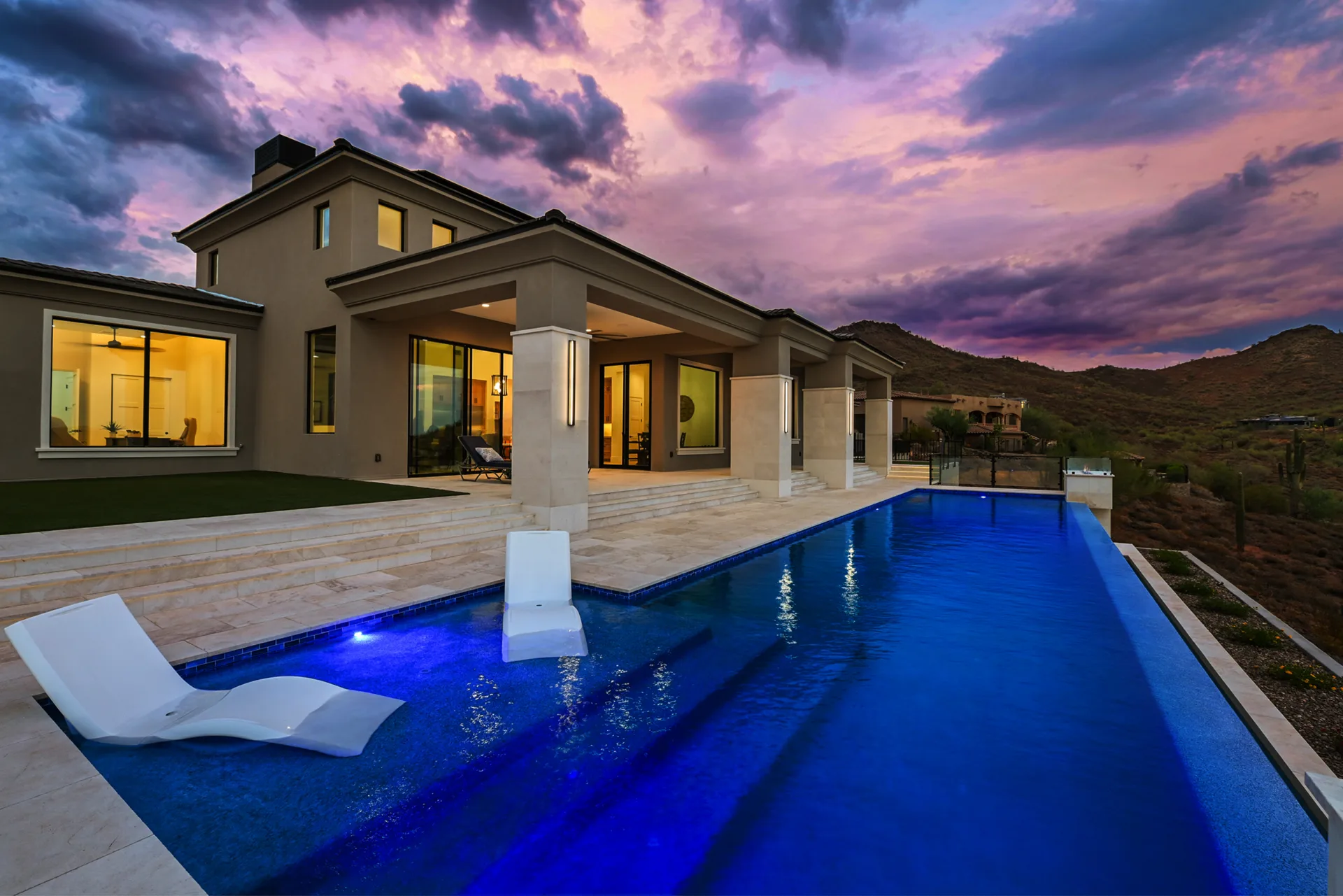
Hardscape is where the landscape connects to the architecture. Material, joint pattern, and edge details should read as a continuation of the house, which is why paving selections happen alongside interior stone and plaster rather than as a separate late decision.
- Travertine or porcelain pavers on patios and pool decks for barefoot comfort
- Sandblasted or exposed-aggregate concrete on drives and motor courts
- Stabilized decomposed granite on paths so it does not migrate into paving after storms
- Board-formed concrete, stone veneer, or integral-color plaster on garden walls to match the house
- Steel or masonry edging where planting meets granite, so lines stay crisp for years
Lighting Turns The Yard Into An Evening Room
Arizona outdoor living happens after dark for much of the year, so landscape lighting decides whether the yard gets used. We plan uplights on specimen trees, grazing light on textured walls, low path lighting, and separate control of the pool and water features so scenes can be dialed down rather than switched all on.
Conduit and transformer locations go in before backfill. Adding a run later means trenching through finished granite and irrigation lines, and it rarely lands where the fixture should have been. Dark-sky ordinances in Cave Creek, Carefree, and parts of Paradise Valley also set fixture and shielding rules that belong in the plan, not in a field decision.
Coordinating Landscape With The Pool And Backyard Build
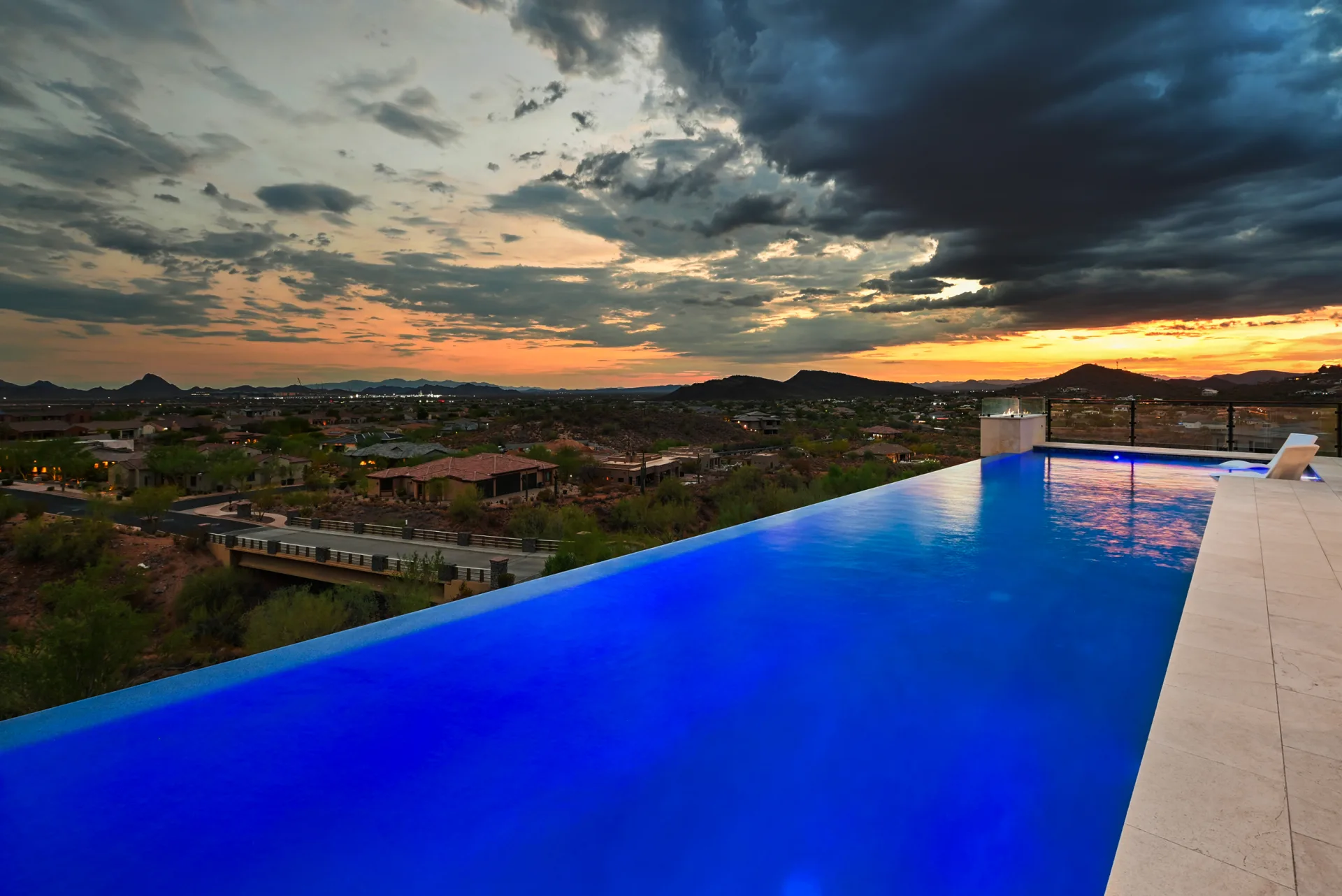
Pool, spa, ramada, outdoor kitchen, and planting all share the same corridor of dirt, and they need one sequence. Shotcrete trucks, boom access, tile crews, and equipment pads have to move through the yard before finish planting, or good plants get destroyed by the next trade. We set that order in the schedule alongside the pool and landscaping scope and the backyard planning work done during design.
Equipment location deserves a real decision. Pool pads, pumps, and irrigation manifolds are noisy and unattractive, so they get screened positions with service access, not the first convenient side yard.
Views, Screening, And Neighbors
On a hillside lot in Paradise Valley or a view street in Silverleaf, the landscape has two jobs at once: frame the mountain view and block the neighbor. Those goals fight each other if planting is placed without standing in the room and looking out.
- Keep view corridors low with grasses and groundcover, never canopy trees
- Push screening mass to the side property lines where the view is not
- Use grade changes and low walls instead of tall hedges on tight lots
- Check mature heights against second-story sightlines, not the size at install
- Confirm HOA and design review plant lists before ordering specimen material
Maintenance And The First Two Years
A desert landscape looks its worst about a year in, when plants have not filled and pruning mistakes are obvious. Establishment watering, correct structural pruning on young trees, and holding off on shearing shrubs into balls are what get you to the mature version the design promised.
We hand over irrigation zone maps, plant schedules, and controller programming at closeout, and we walk the yard with the homeowner and their maintenance crew. If you want to see how planting, hardscape, and lighting read once they mature, our portfolio shows completed work across Scottsdale and Phoenix, and our process covers where landscape decisions land in the schedule.
Frequently Asked Questions
- When Should Landscape Design Start On A Custom Home?
- During architectural design, not after framing. Grading, drainage, tree locations, sleeves, and conduit all have to be set before hardscape and backfill, so the landscape architect belongs in the early design conversations.
- What Are The Best Trees For A Scottsdale Yard?
- Ironwood, palo blanco, velvet mesquite, and blue palo verde all perform well and give real canopy. Choose based on the position and how much shade and litter you want, then give each tree adequate root space and its own irrigation zone.
- Does Desert Landscaping Still Need Irrigation?
- Yes. Native and desert-adapted plants need regular water to establish, and most need supplemental deep watering through summer to look good rather than survive. Drip zones grouped by exposure and demand handle that efficiently.
- How Do You Keep Decomposed Granite From Washing Out?
- Correct grading, stabilized granite on paths, and hard edging where planting meets paving. Without those, monsoon runoff moves granite into patios and driveways every season.
Start the conversation